
Modes, or church modes, are scales that originated in the medieval period. This article offers a general introduction; in a future post, we’ll explore their properties in more depth. For simplicity, all examples will use the key of C.
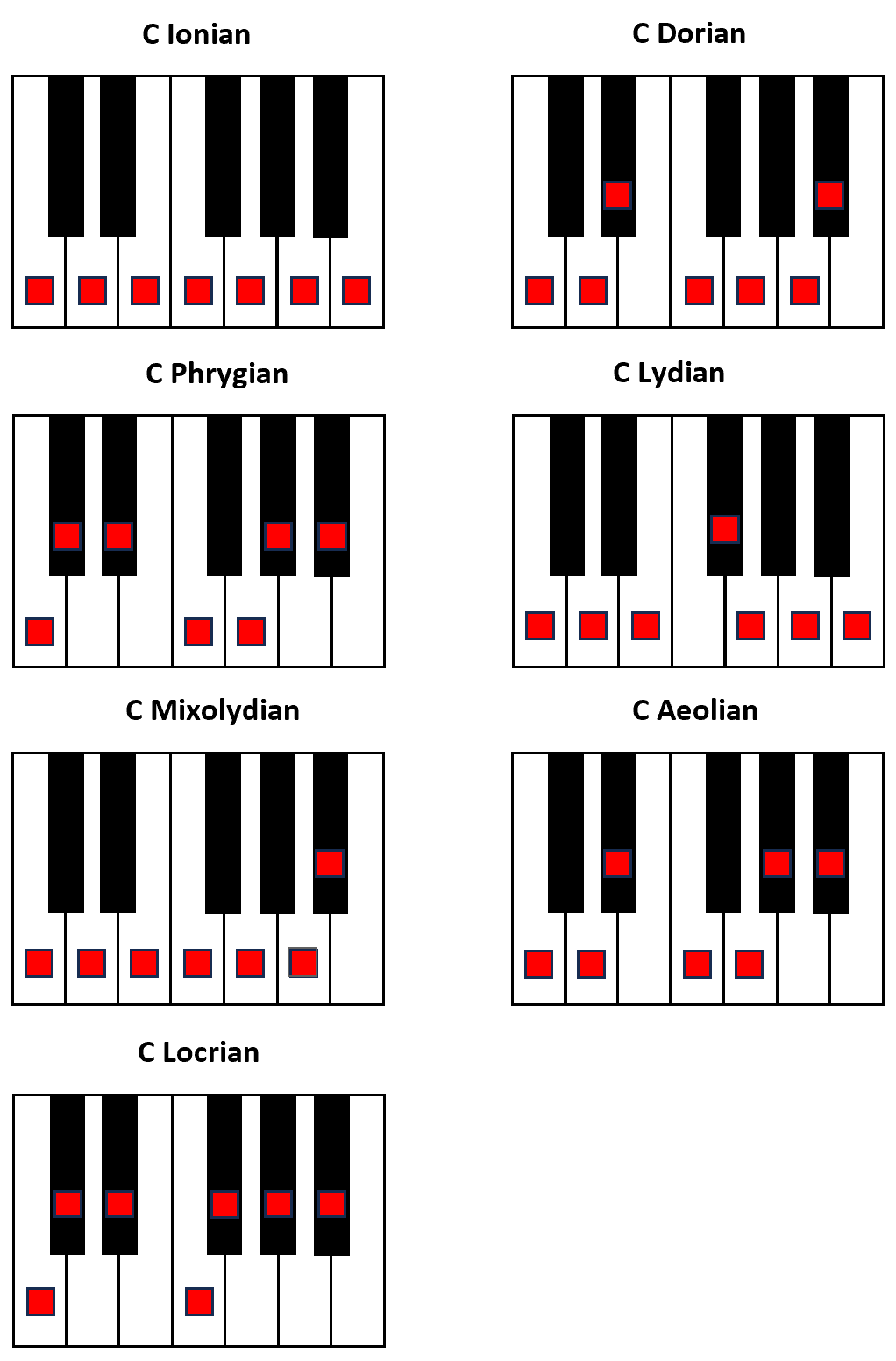
| Mode | Relation to the Major Scale |
|---|---|
| Ionian | – |
| Dorian | b3, b7 |
| Phrygian | b2, b3, b6, b7 |
| Lydian | #4 |
| Mixolydian | b7 |
| Aeolian | b3, b6, b7 |
| Locrian | b2, b3, b5, b6, b7 |
Now that we’ve explored the modes, a natural question arises: where do they come from? Why do they contain these specific intervals—and not others? One intuitive way to understand their construction is by examining the familiar major scale, represented over two octaves. We’ll build a new scale starting from each of the seven notes in the major scale.

| Starting note | Intervals | Mode |
|---|---|---|
| C | 2s 2s 1s 2s 2s 2s 1s | Ionian |
| D | 2s 1s 2s 2s 2s 1s 2s | Dorian |
| E | 1s 2s 2s 2s 1s 2s 2s | Phrygian |
| F | 2s 2s 2s 1s 2s 2s 1s | Lydian |
| G | 2s 2s 1s 2s 2s 1s 2s | Mixolydian |
| A | 2s 1s 2s 2s 1s 2s 2s | Aeolian |
| B | 1s 2s 2s 1s 2s 2s 2s | Locrian |
We can see that, by starting at each of the seven notes, the resulting scale has different intervals. Each of these resulting scales is given a special name and it is called a “mode”. If we now apply these intervals by starting always with C, we obtain the following scales.
| Mode | Notes |
|---|---|
| C Ionian | C D E F G A B |
| C Dorian | C D Eb F G A Bb |
| C Phrygian | C Db Eb F G Ab Bb |
| C Lydian | C D E F# G A B |
| C Mixolydian | C D E F G A Bb |
| C Aeolian | C D Eb F G Ab Bb |
| C Locrian | C Db Eb F Gb Ab Bb |
The same can of course be done in any key.
Let us now learn more about the origins of the modes. According to Copilot[1],
The church modes, also known as the medieval modes or Gregorian modes, are a system of musical scales that originated in the Medieval period. These modes formed the basis of Western music theory and practice during the Middle Ages and the Renaissance.
Origins
The church modes have their roots in ancient Greek music theory, which was adopted and adapted by medieval church musicians. They were used to classify and organize chants used in the liturgy of the Roman Catholic Church. The modes were named after regions and tribes of ancient Greece, although the names had little to do with the actual musical practices of those regions.
These modes were fundamental in shaping the melodic and harmonic language of Western music. Over time, the major and minor scales (Ionian and Aeolian modes) became the dominant scales in Western music, but the church modes are still used today for their unique tonal qualities and historical significance.
[1] Copilot version: 23 November 2024, prompt: “what are the church modes in music and where do they come from?”
 Alaraph